
Volunteer Lawyers Program
Unrepresented Litigants
In General
How Do I Meet With A Volunteer Lawyer?
What is the Difference Between a Volunteer Lawyer
and a Help Center Court Attorney?
What Should I Bring to the Help Center?
How Do I Get to the Help Center?
Read What Satisfied Litigants Have to Say
If you are not represented by an attorney and you need legal advice about a residential landlord-tenant law matter, the Housing Court’s Volunteer Lawyers Program can help you.
Our trained volunteer lawyers provide free legal and procedural
information and advice in the Housing Court’s Help Centers.
Our volunteer lawyers will review your court papers, discuss the
strengths and weaknesses of your individual case, help you fill
out forms, and assist you in creating a plan to defend or prosecute
your case. They will not represent you in court or file papers
on your behalf. You are responsible for meeting all court dates
and for all filing deadlines. Should you need representation, the
volunteer lawyer can refer you to a Legal Aid or Legal Services office
or to a Bar Association Legal Referral Service.

How Do I Meet With A Volunteer Lawyer?
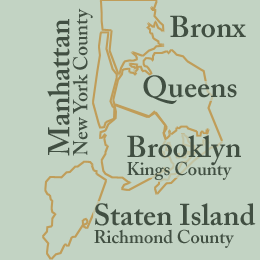
If you are not represented by an attorney and you need legal advice about a residential landlord-tenant law matter, consult the appropriate calendar below to see if a volunteer attorney is scheduled to appear in one of the Housing Court’s Help Centers located nearest you.
If there is a volunteer lawyer scheduled on a particular date and at a particular time, you should go to that Help Center at that time, and inform the staff that you wish to meet with a volunteer lawyer. Please note that the information in the calendars is updated weekly, and may not reflect last-minute cancellations or other changes made to the schedule.
In addition, please note that if there are no volunteer lawyers scheduled to appear on a given day, you may still find it helpful to go to the Help Center to meet with one of the Help Center Court Attorneys to discuss a pending Housing Court case.
CALENDARS
Bronx County |
Kings County |
New York County |
Queens County |
Richmond County |
Harlem |
If you wish to see a Volunteer Attorney in the Harlem Community
Justice Center, you must check in with the Help Center on Mondays
and Thursdays for availability.
What is the Difference Between a Volunteer Lawyer and a Help Center Court Attorney?
Help Center Court Attorneys work for the Civil Court. These experienced lawyers, many of whom have years of landlord-tenant law expertise, meet daily with unrepresented litigants in the Help Centers. They provide referrals to appropriate government agencies, social service organizations, and legal services providers, and can explain court procedures, legal terminology, and available options. Like the volunteer lawyers, they provide these services free of charge.
Because Help Center Court Attorneys work for the Civil Court, they are not permitted to give legal advice to either owners or tenants. This means that they cannot interpret the law as it relates to your situation or recommend that you follow a specific course of action. In addition, they cannot represent you in court or file papers on your behalf.
Volunteer lawyers may provide legal advice, and may be able to devote more time to discuss the strengths and weaknesses of your individual case. Like the Help Center Court Attorneys, they cannot represent you in court or file papers on your behalf.
If there are no volunteer lawyers scheduled on a given date, and
you have questions about a pending Housing Court case, you should
still consider going to the Help Center to discuss your concerns
with one of our experienced and knowledgeable Help Center Court
Attorneys.
What Should I Bring to the Help Center?
Whether you will meet with a volunteer lawyer or a Help Center Court Attorney, you should bring any court papers and relevant notices you received, information from relevant social service or governmental agencies, any previous stipulations or court orders, and a marshal’s notice, if you received one.
You should also bring any documents which may prove your case or disprove the other side’s case.
Examples:
• copy of lease/ lease renewals/agreements
• rent payment history/rent breakdown
• rent receipts
• petition and notice of petition
• answer
• stipulation and/or court order
• marshal’s notice
• deed, if relevant
• notice of termination/notice to cure
• Section 8 documentation
How Do I Get to the Help Center?
Help Center locations,
hours, and directions are
available on the Civil Court’s web site.