Hon. Dianne T. Renwick, Presiding Justice
Susanna Molina Rojas, Clerk of the Court
1970 - Present
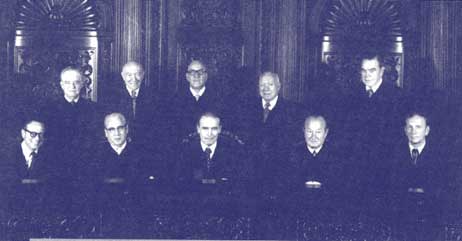
Associate Justices Theodore R. Kupferman, Arthur Markewich,
Presiding Justice Owen McGivern, Associate Justices Emilio Nunez, Francis T. Murphy Jr.
Standing left to right: Associate Justices George Tilzer, Aron Steuer, Vincent A. Lupiano,
Louis Capozzoli, Myles J. Lane.
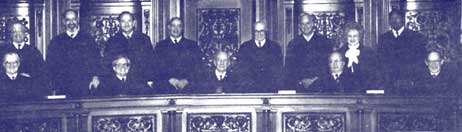
Associate Justices Richard W. Wallach, Ernst H. Rosenberger, E. Leo Milonas, John Carro,
Sidney H. Asch, Bentley Kassal, Betty Weinberg Ellerin, George Bundy Smith,
Joseph P. Sullivan, Theodore R. Kupferman, Presiding Justice Francis T. Murphy,
Associate Justices Leonard H. Sandler, David Ross
Presiding Justice
1969-1974;
1975-1977
In the beginning of the 1970's the increasingly acute problem of the lack of available housing for the poor was thrust to the forefront of the Court’s calendar.
Although not new to New York City – the Bowery had an estimated 10,000 homeless men early in the century – the problem now assumed a new dimension, with whole families evicted or otherwise forced out of their living quarters. In the early 1980's, a series of cases declared that the homeless had a right to shelter at City expense, if necessary. A massive City shelter program was already underway, with buildings such as armories and City-leased residential hotels separately serving single men, single women and families. In a continuing line of cases started in the 1980's, the Court considered issues ranging from the maximum legal waiting period for shelter placement, to the quality and amount of shelter food, to the benefits available to the homeless who had been diagnosed as HIV positive. By 1995, the City counted a shelter population of approximately 25,000, and the lower courts continued to consider questions regarding the rights and benefits due the homeless.
As social conditions and standards changed, new questions before the Court involved that most basic of social units, the family. After a landmark case in the 1950's afforded juveniles certain legal rights of their own, the Court was left to ponder the respective rights and responsibilities of the non-traditional family. The Court set forth the child support responsibilities and unwed parents, and the visitation rights of men who fathered children through sperm donation. One case described the visitation rights of a grandparent, another the validity of adult adoption.
Presiding Justice
1974-1975
The subject of asbestos-related lung diseases arose in a 1993 case involving former workers at the Brooklyn Naval Shipyard. In this class action, the plaintiff class of injured workers was awarded $73 million in damages.
New medical technology resulted in a court decision regarding the sufficiency of DNA testing in paternity cases. These and other cases challenged the Court to alter a definition of “family” that had governed the law for centuries. In the area of products liability, the Court gave new consideration to the parameters of individual and corporate responsibility. In a landmark case, manufacturers of the drug DES were found liable for injuries sustained by a plaintiff who had been damaged in utero after her mother had ingested that prescription drug. In a ruling that substantially altered the legal doctrine of privity, or the necessity for a direct relationship between an injured person and the defective product’s manufacturer, the Court held that the defendant, who had sold DES during the relevant period, was liable for its market share of the drug even absent proof that it had sold the specific pills in question
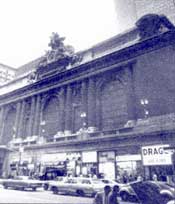
In 1975, the Court ordered
the preservation of New York’s Grand Central Terminal
as a City landmark. Today, despite a
dispute over air
rights, Grand Central remains as both a New York historic
treasure and a vital transportation center.
One of the Court’s more unusual cases involved a challenge by the donor to the Museum of the American Indian, to the proposed transfer of his donated collection into the stewardship of the Smithsonian Institute. The book collection at issue had been turned over by the Museum to a local library.
Another case of interest involved allegations of libel brought by a manufacturer of biological products which had used primates for research. The defendant was an internationally-known scientist who had publicly criticized the corporation’s plans for acquiring and using more chimpanzees. The Court held that the letter in question, which accused the plaintiff of “scientific imperialism,” was an expression of opinion and thus not defamatory.
In a case that reverberated throughout the City’s criminal justice system, the Court held that a delay more than 24 hours between a person’s arrest by the police and the arraignment in court was presumptively unnecessary and, unless explained, constituted a violation of a prisoner’s legal rights. In that case, one person had been held for 94 hours before arraignment on charges of peddling an umbrella without a license and another for 98 hours on a shoplifting charge.
Throughout the 1980's and 1990's, issues of popular culture continued to engage the Court’s attention.
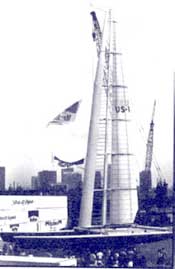
with a space-age solid wing mast.
In one unusual case involving a hit play, Six Degrees of Separation, the plaintiff sued the play’s author, claiming that the author had appropriated elements of the plaintiff’s life. The Court denied that claim. In a similar action, the author of a best-selling book was sued by a psychiatrist whose name had been used for a fictional character. As American fashion designers gained in popularity, the Court heard cases involving superstar models and agencies.
In a unique case, the Court was faced with a decision involving the rightful ownership of the America’s cup yachting trophy.
This Court’s subsequent ruling gave the trophy too the San Diego Yacht Club, holding that the Club’s unusual catamaran design was permitted under the race’s charter. The Court noted that “for 140 years, challengers and defenders have spent fortunes...to gain any speed advantage...to enhance their chance of victory. That is the very essence of America’s Cup competition.”
Other sports cases that have come before the Court involved baseball pitcher Warren Spahn, baseball owner George Steinbrenner, football great Joe Namath and wheelchair athletes seeking to enter marathon competitions. In a case involving the dispute over George Brett’s use of pine tar on a baseball bat in a game between the New York Yankees and the Kansas City Royals, an Appellate Division Justice rendered his decision with the traditional umpire’s call: “Play ball!”
